
BOOK📕Chaos Control - How to Build a Practice That Runs Without You - Chapter One
CHAPTER ONE - The Honeymoon Period
Building A Practice That Can Run Without You
Whether you are just considering starting a private practice or are already a seasoned healthcare business owner - ‘building a practice that can run without you’ is the holy grail of all private practitioners.
This book takes you through the full life cycle of private practice - from the honeymoon period, through the daily grind of treat-sleep-repeat, to how a simple one-hour-a-week system can put your practice on autopilot so it runs with or without you.
When the Motor Is Bigger Than the Machine
To understand what happens in the early days of private practice - I want to introduce you to a metaphor that will run through this entire book.
The motor and the machine.
Think of your business as two interlocking cogs. The first cog is YOU. You are the Motor - the driving force, the energy, the expertise, the passion. Every decision made, every patient treated, every relationship built is because of you. You are the reason the business exists, and in these early days, you are also the reason it thrives.
The second cog is YOUR BUSINESS - the Machine. Right now, the Machine is small. You might have one or two treatment rooms, a modest patient list, maybe a part-time receptionist, and a small pile of admin and bills that you manage yourself probably on a Sunday evening before ironing your uniform and prepping for the week ahead.
But here is the delusive thing about the early days: the Motor is bigger than the Machine.
When the Motor is bigger than the Machine, something magical happens. Every unit of effort you put into the Motor produces a direct and proportionate output from the Machine. You work hard, the business grows. You see more patients, the revenue rises. You work on your marketing and the diary fills. The connection between effort and reward is linear and you wonder why you didn’t do this before?
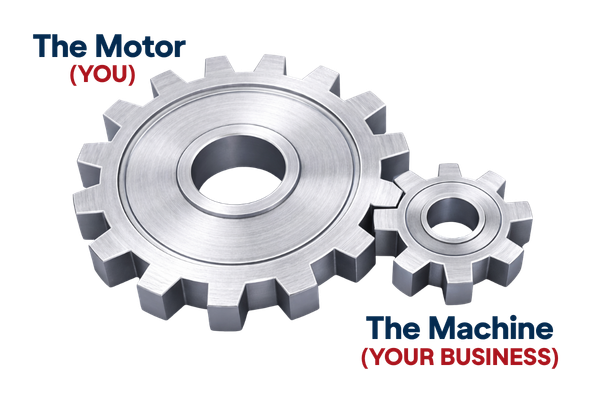
The Cog Metaphor
Throughout this book, we will return again and again to the image of two interlocking cogs: YOU (the Motor) and YOUR BUSINESS (the Machine). In the early days, the Motor is larger. Your effort directly drives the output. But as the business grows, the relationship between the cogs begins to change - and that change is where the trouble starts.
This is why so many healthcare practitioners look back on their first year or two in private practice as some of the most rewarding of their careers. The harder you worked, the better the results. Even when it was exhausting, it felt purposeful - and the rewards went far beyond money.
This is what I call the honeymoon period.
The Honeymoon Period
Cast your mind back to the day you opened the doors of your practice for the first time.
Maybe it was a simple domiciliary round, or a room rental in a doctors surgery. Or maybe you’d taken the plunge and leased that unit on the high street - and now your practice name is proudly presented to the world. No matter how it started - you had done it!
After years of university, clinical placements, and working under someone else's roof and someone else's rules, you had broken free. You had built something of your own. You were your own boss with your own practice, and the world of opportunity ahead.
No More Clinical Constraints
As an employed practitioner, your clinical decisions were never entirely your own. There were protocols to follow, budget constraints, managers to please and targets to hit. Even when well intended - this limited your ability to apply your own clinical judgement. In essence - you were the practitioner someone else wanted you to be.
But in your own practice, for the first time ever, you were truly free.
You could now to treat patients how you felt they should be treated. Applying your own pathways and protocols. Using the latest equipment and skills you developed on the training courses that you decided to attend. Developing your own specialism that aligns with your interests and expertise.
Gone were the days when you had to squeeze a forty-five minute complex patient into a twenty minute slot because someone else manages your diary.
Now you had clinical autonomy. It was one of the most compelling reasons you stepped into private practice... and one of main reasons you have stuck it out ever since.
You Are The Bride - Not The Bridesmaid
There is something that happens when you open your own business that changes how you see yourself. You are no longer just a practitioner. You are the practice owner. An entrepreneur. A person who had such belief in themselves that they cast away the safety net of employment with the steely determination and belief that they could, should and would make it on their own.
This identity shift matters more than people realise. It shows up in how you talk about your work at dinner parties, how you introduce yourself at professional events, and quietly - in moments of early morning self-reflection - in how you feel about the person you've become and the life you are creating.
This is why so many practitioners describe their first years in practice as the best of their professional lives - even when it was objectively exhausting. The exhaustion was felt purposeful.
You Are Laying The Foundations Of Your Future
There is a particular pleasure in building something from nothing. You watch your patient list grow from a handful of early adopters into a consistently full diary. You take on your first member of staff, move beyond your small premises, and step into a space that reflects the practice you are creating.
These milestones are genuinely thrilling, and they happen frequently in the early years. The business is growing, the Motor is driving the Machine, and every week you are adding to the building blocks of your business.
Financial Freedom
In employment, your earning potential has a ceiling. It might be a generous ceiling - a good NHS band or a competitive private sector salary - but it is a ceiling nonetheless. In private practice, for the first time, your earnings are directly linked to the effort you put in.
In the Honeymoon Period, this feels electric. Every patient is not just a clinical interaction; it is also a direct contribution to your livelihood. The more people you treat, the more money you make.
Many practice owners describe the first time they exceeded their employed salary through their own private practice as a profound moment - not just financially, but psychologically.
If you needed proof you had made the right decision - this was it!
The First Cracks Appear
But then, even in the Honeymoon Period - when everything is going so well - practice owner begins to notice something has changed. Nothing to worry about... little things... but it just doesn't quite feel the same.
The diary is full, which is great, but there are now patients waiting two weeks for an appointment and you are concerned they will go elsewhere. You have taken on a part-time associate, which has helped with volume, but now you spend time supervising, answering their questions, and pacifying patients that don't want to see them.
The administration begins to grow. Invoicing, accounts, your first HMRC bill, staff rotas, equipment maintenance, stock control - the list of responsibilities outside the treatment room continues to expand, while the time available to manage them steadily diminishes.
Your simple website and word-of-mouth marketing, which was fine in the early days, now feels like it deserves more attention. Your competitors have a better online presence and you see them getting attention on social media. You keep meaning to finish those patient information leaflets but never quite find the time.
You wonder how other people are doing it - but you convince yourself that it will get easier in time.
A Moment Of Reflection
Think back to your own Honeymoon Period. When did you first notice the balance shifting? When did the business start to feel like it was demanding more than it was giving back? Most practice owners can pinpoint the moment precisely - even if they did not recognise it as significant at the time.
They are the entirely predictable and manageable growing pains of a successful practice. But they are the first signs that the Machine is getting larger. And as the Machine grows, the relationship between the two cogs begins - almost imperceptibly at first - to change.
Why Every Honeymoon Eventually Ends
Here is the uncomfortable truth about the Honeymoon Period: it’s a ‘period’ and all periods have a start and an end.
You did not do something wrong. Your business was not failing. In fact, quite the opposite. The Honeymoon Period ends precisely because your business starts to succeed. As the Machine grew - more patients, more staff, more complexity, more moving parts - it inevitably began to exceed the capacity of the Motor…and the Motor began to feel the strain.
This is not a failure or a lack of effort. It is a mechanical inevitability. A small motor can drive a small machine with ease. But as the machine grows larger and more complex, the forces it exerts on the motor increase. The motor has to work harder and harder just to maintain the same output. And eventually - if nothing changes - the motor begins to burnout.
This is the tipping point - which we will explore in much more detail in the next chapter. But it is important to understand, even at the outset, that the end of the Honeymoon Period is not a sign that something has gone wrong. It is a sign that something has gone right - and that the business has grown to a point where it needs something the Motor alone cannot provide.
That something is the reason I wrote this book.
But we are getting ahead of ourselves. Before we talk about solutions, we need to spend a little more time on the problem - because most practice owners who struggle have never quite understood what the problem actually is.
They know things feel hard. They know they are working too much and earning too little. They know they feel trapped in a cycle they cannot seem to break.
What they do not know yet… is why?
Chapter Summary
The Honeymoon Period is the early phase of private practice ownership when the Motor (YOU) is larger than the Machine (YOUR BUSINESS). During this phase:
• Effort and reward are directly and satisfyingly linked.
• Clinical autonomy, financial freedom, and the joy of building create genuine fulfillment.
• The business grows rapidly and the owner feels energised and purposeful.
• The first signs of growing complexity begin to appear - extra staff, administration, marketing demands - but remain manageable.
The Honeymoon Period ends not because the practice fails, but because it succeeds. As the Machine grows, it begins to exert greater forces on the Motor - setting the stage for the challenge explored in the next chapter.
Coming Up in Chapter Two
When the Machine Overtakes the Motor - The tipping point where freedom becomes a trap. I explore what happens when business maturity outpaces the owner's capacity to drive it, and why so many practitioners find themselves working longer hours for proportionally less reward.